
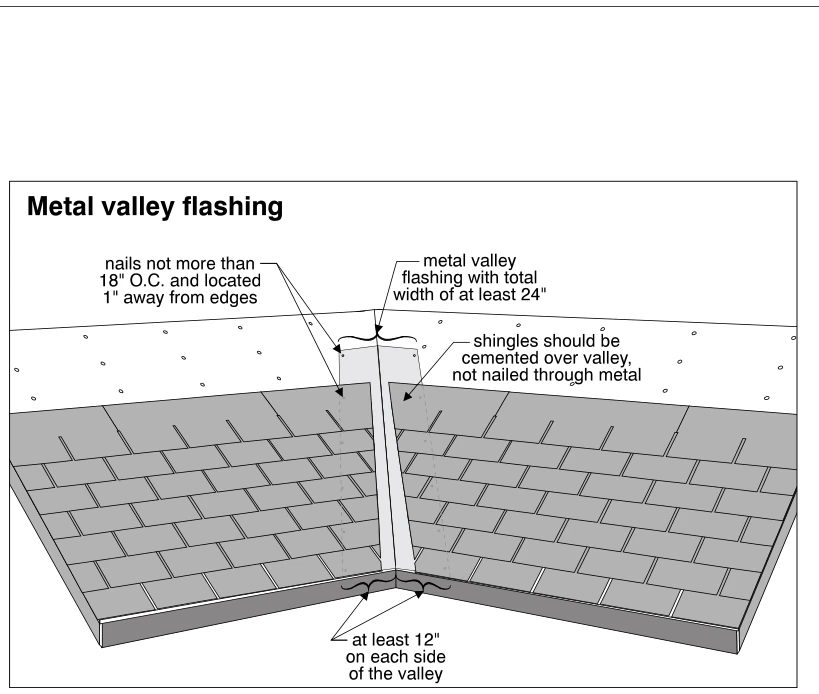
Related illustrations
 0062
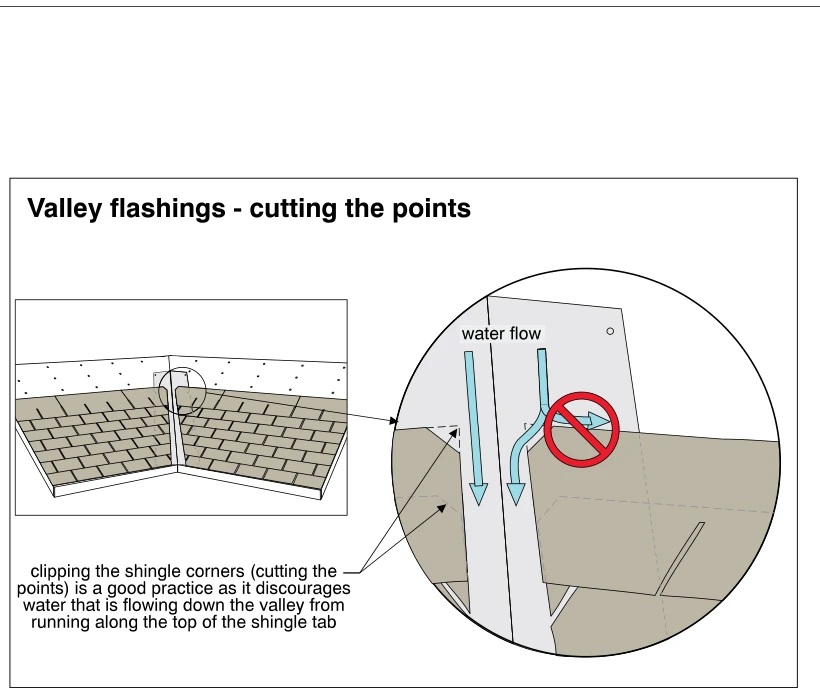
0062Valley flashings - cutting the points
· p. 19
The illustration shows a shingled roof valley with exposed metal valley flashing between two roof slopes. An enlarged detail shows the upper corners of shingles bordering the valley clipped back, with dashed lines indica
 0053
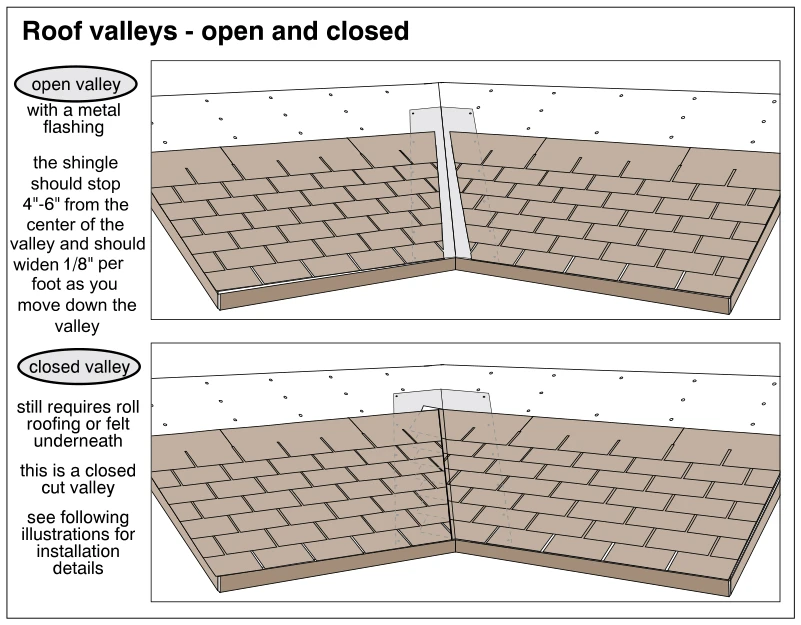
0053Roof valleys - open and closed
· p. 17
Two diagrams compare open and closed valleys at the intersection of sloping shingle roof planes. The upper diagram shows an open valley with exposed metal flashing between the shingle edges. Its annotation specifies that
 0061
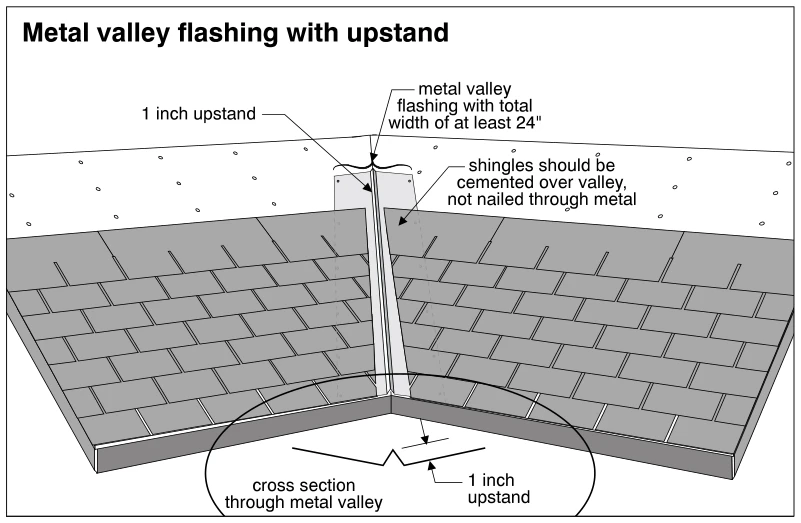
0061Metal valley flashing with upstand
· p. 18
Two shingled roof slopes intersect at an open valley lined with metal flashing. The flashing has a central 1-inch upstand, illustrated both along the valley and in an enlarged cross section below. An annotation specifies
 0060
0060Metal valley flashing - alternate application
· p. 18
The illustration shows an open metal valley between two intersecting shingle-covered roof slopes. Metal flashing is centered in the valley, with a total width of at least 24 inches and at least 12 inches on each side. Na
 0058
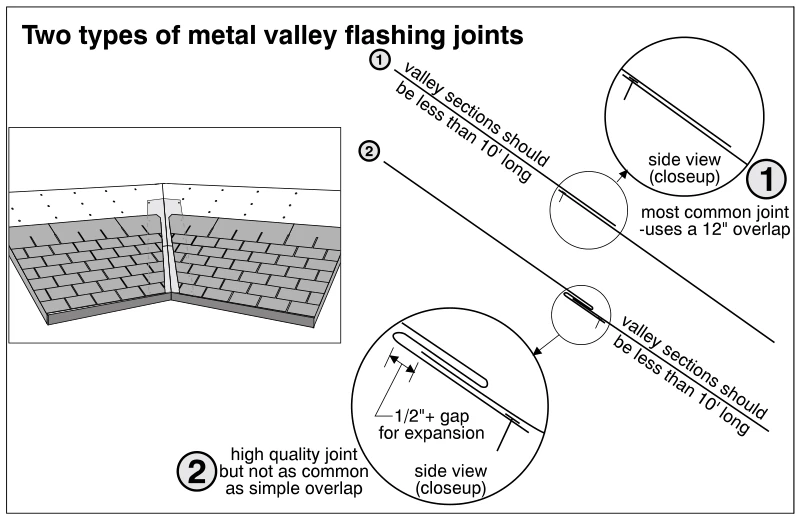
0058Two types of metal valley flashing joints
· p. 18
The illustration shows metal valley flashing between two adjoining shingled roof slopes and compares two joints used to connect flashing sections. The first joint is a simple lap with a 12-inch overlap, identified as the
 0059
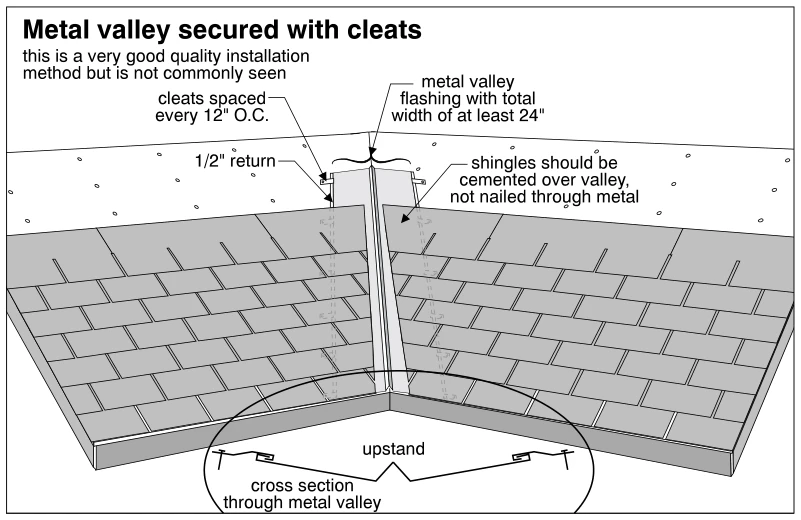
0059Metal valley secured with cleats
· p. 18
The illustration shows an open metal valley between two shingled roof slopes, with flashing secured along its edges by cleats spaced every 12 inches on center. The flashing is labeled as having a total width of at least
 0056
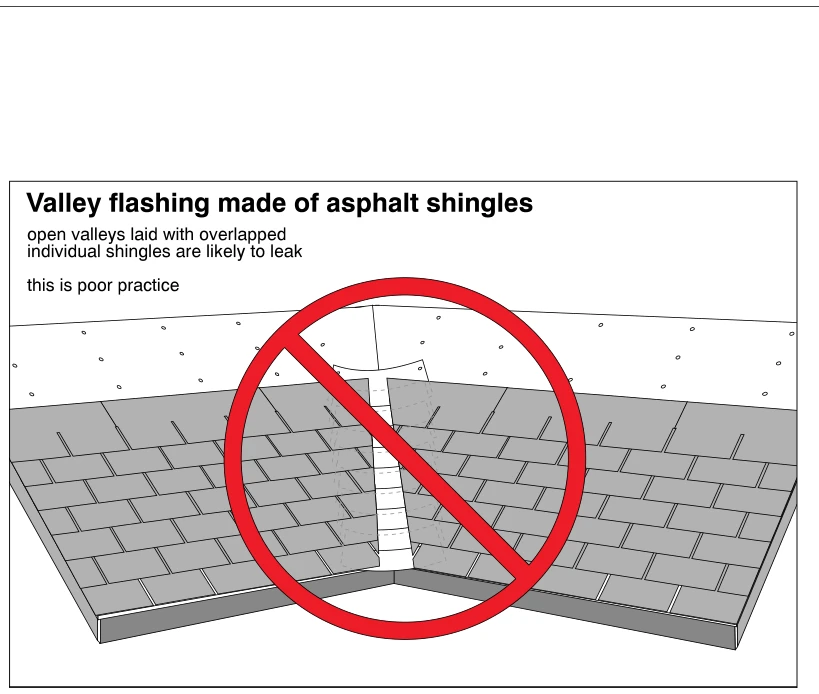
0056Valley flashing made of asphalt shingles
· p. 18
Two asphalt-shingled roof slopes meet at an open valley. Overlapping individual shingles form the valley lining, with the adjacent roof shingles cut back to expose the drainage channel. A large red prohibition symbol mar
 0055
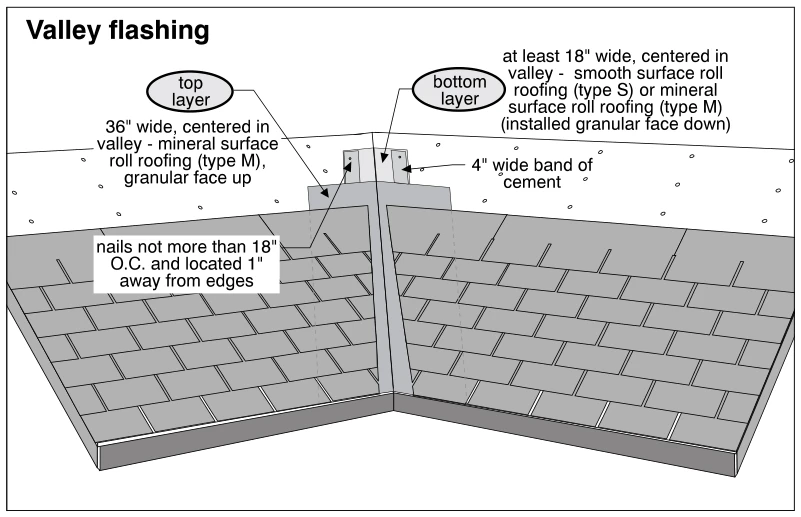
0055Valley flashing
· p. 17
The illustration shows two shingled roof slopes meeting at an open valley lined with two layers of roll roofing. The bottom layer is at least 18 inches wide and centered in the valley, using either smooth-surface type S